← Back to publications

A visual guide to my research

Research,
explained.

The questions behind the papers. The ideas that move them forward. A visual tour of safe control, intelligent estimation, and learning.

Original conceptual diagrams · Sources linked with every summary

01 — 09
01Secure control2026

Can a system stay safe—and keep tracking—during an attack?

Use a graded response: preserve tracking when it is safe, and hand control to a local fallback when it is not.
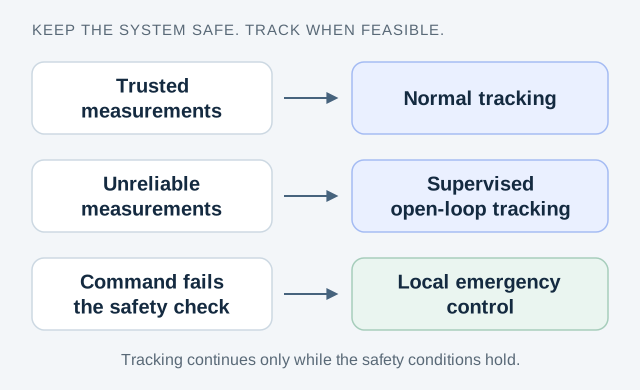
Three responses with one priority: respect the constraints. This is a conceptual decision view of the architecture.
Three responses with one priority: respect the constraints. This is a conceptual decision view of the architecture.View full size ↗

The problem

Corrupted measurements or commands can push a constrained physical system outside its safe operating region. Switching immediately to an emergency controller can also sacrifice useful tracking performance.

The main idea

Learn worst-case reachable sets from data. Combine an anomaly detector and a controller-side tracking supervisor with plant-side command verification and emergency control. When measurements become unreliable, supervised open-loop tracking can continue while its safety conditions hold.

What the paper shows

The author manuscript presents safety arguments and a simulation example showing how the architecture protects constraints while retaining tracking where feasible.

Scope & limitations

The analysis concerns constrained linear systems, bounded disturbances, sufficiently informative data, a suitable tracking controller, and trusted local safety components. It does not guarantee uninterrupted tracking under every attack.

Journal article · European Journal of Control

A Data-Driven Approach to Preserve Safety and Reference Tracking for Constrained Cyber-Physical Systems Under Network Attacks

Mehran Attar and Walter Lucia

Summary based on: Full author manuscript · arXiv v2, June 2026 ↗

View citation BibTeX + copy

Journal citation uses the 2026 publisher record. The visual summary follows the open author manuscript.

@article{attar2026safetytracking,
  title = {A Data-Driven Approach to Preserve Safety and Reference Tracking for Constrained Cyber-Physical Systems Under Network Attacks},
  author = {Mehran Attar and Walter Lucia},
  year = {2026},
  journal = {European Journal of Control},
  pages = {101661},
  doi = {10.1016/j.ejcon.2026.101661}
}
02Secure control2024 online · 2025 issue

What should happen when a network command becomes unsafe?

Give the plant a local safety check and an emergency controller that can act independently of the network.

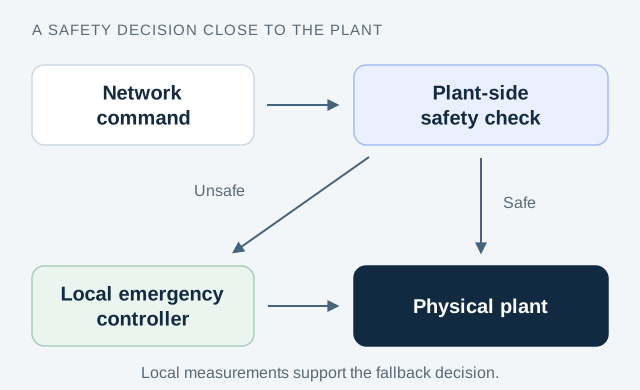
The plant-side gate selects a verified network command or a locally computed emergency action.
The plant-side gate selects a verified network command or a locally computed emergency action.View full size ↗

The problem

A remote controller may receive manipulated measurements or send a command that is changed in transit. Detecting an anomaly alone does not keep the physical process within its constraints.

The main idea

A data-driven detector checks measurement consistency. At the plant, a safety module tests commands using worst-case reachable sets. Unsafe commands are replaced by a local set-theoretic MPC action that moves the state toward a robust invariant region.

What the paper shows

Two-tank simulations illustrate constraint preservation under attacks on measurements and actuation, including a case where the detector’s alarm is compromised.

Scope & limitations

The guarantee depends on linear dynamics, bounded uncertainty, informative data, a certified feasible region, and trusted plant-side measurements and control. Emergency operation prioritizes safety; it can interrupt reference tracking.

Journal article · International Journal of Robust and Nonlinear Control

A Data-Driven Safety Preserving Control Architecture for Constrained Cyber-Physical Systems

Mehran Attar and Walter Lucia

Summary based on: Full author manuscript · arXiv v2 ↗

View citation BibTeX + copy

Published online in 2024; the journal issue and citation are dated 2025.

@article{attar2025safety,
  title = {A Data-Driven Safety Preserving Control Architecture for Constrained Cyber-Physical Systems},
  author = {Mehran Attar and Walter Lucia},
  year = {2025},
  journal = {International Journal of Robust and Nonlinear Control},
  volume = {35},
  number = {1},
  pages = {343--358},
  doi = {10.1002/rnc.7654}
}
03Secure control2023

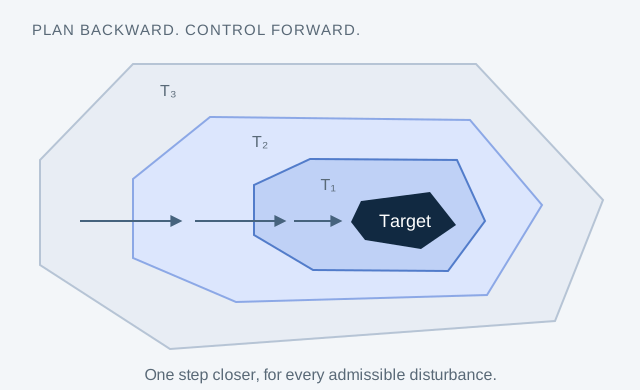
Which states can safely reach the target without a known model?

Work backward from a safe target to learn where a controller can act with guarantees.

Illustrative controllable sets: choose an action that reaches the preceding region despite bounded disturbances. Geometry is schematic.
Illustrative controllable sets: choose an action that reaches the preceding region despite bounded disturbances. Geometry is schematic.View full size ↗

The problem

Robust MPC needs to know which states can reach a target despite disturbances. Standard set computations usually require a known dynamical model.

The main idea

Construct conservative zonotopic inner approximations from noisy trajectories in an extended state–input space. Compute a family of regions offline; online, select admissible inputs using those regions without revisiting the raw data or an explicit system model.

What the paper shows

The paper establishes recursive admissibility and compares the controller with a model-based counterpart in simulation. The illustrated data-driven controller reaches the terminal region, with additional steps due to conservative sets.

Scope & limitations

The method assumes linear dynamics, known disturbance bounds, sufficiently informative data, and an appropriate terminal region. Inner approximations can exclude feasible states and reduce performance.

Journal article · IEEE Control Systems Letters

Data-Driven Robust Backward Reachable Sets for Set-Theoretic Model Predictive Control

Mehran Attar and Walter Lucia

Summary based on: Full author manuscript · arXiv v6 ↗

View citation BibTeX + copy
@article{attar2023backward,
  title = {Data-Driven Robust Backward Reachable Sets for Set-Theoretic Model Predictive Control},
  author = {Mehran Attar and Walter Lucia},
  year = {2023},
  journal = {IEEE Control Systems Letters},
  volume = {7},
  pages = {2305--2310},
  doi = {10.1109/LCSYS.2023.3286776}
}
04Secure control2023

Can changing the transmitted data expose a stealthy attack?

Change the measurement representation so an attacker cannot simply reuse a complete, unchanged view of the plant.

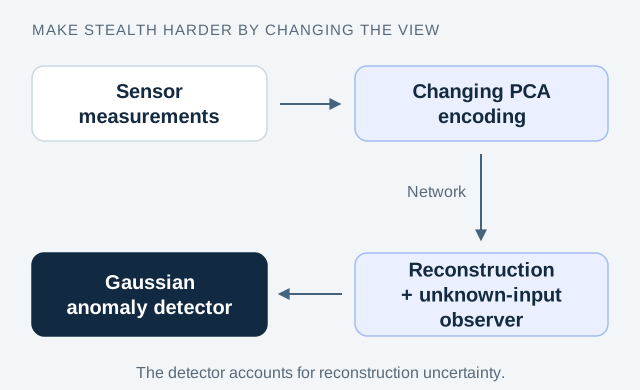
The changing encoding limits the information exposed in transit; reconstruction and observer-based tests support detection.
The changing encoding limits the information exposed in transit; reconstruction and observer-based tests support detection.View full size ↗

The problem

Replay and covert attacks can be constructed to evade conventional detectors by making manipulated signals look consistent with normal operation.

The main idea

Encode sensor measurements using a randomly changing lower-dimensional PCA representation. Reconstruct measurements at the receiver, estimate states and unknown inputs with an observer, and use the estimated unknown inputs in a Gaussian anomaly detector.

What the paper shows

The analysis establishes detection properties for the considered replay and covert attacks. Quadruple-tank simulations demonstrate the architecture and compare attack responses.

Scope & limitations

The results depend on the specified system, observer, encoding, uncertainty, and attacker assumptions. Reconstruction introduces an error that must be accounted for. The paper studies detection; automatic attack mitigation is a separate problem.

Journal article · IEEE Transactions on Control of Network Systems

An Active Detection Strategy Based on Dimensionality Reduction for False Data Injection Attacks in Cyber-Physical Systems

Mehran Attar and Walter Lucia

Summary based on: Full author manuscript · author-hosted PDF ↗

View citation BibTeX + copy
@article{attar2023detection,
  title = {An Active Detection Strategy Based on Dimensionality Reduction for False Data Injection Attacks in Cyber-Physical Systems},
  author = {Mehran Attar and Walter Lucia},
  year = {2023},
  journal = {IEEE Transactions on Control of Network Systems},
  volume = {10},
  number = {4},
  pages = {1844--1854},
  doi = {10.1109/TCNS.2023.3244103}
}
05Robotics & estimation2018 online · 2019 issue

How can an observer estimate dynamics that are not fully known?

Estimate the system state and a lumped disturbance together, using a principled time-varying design.

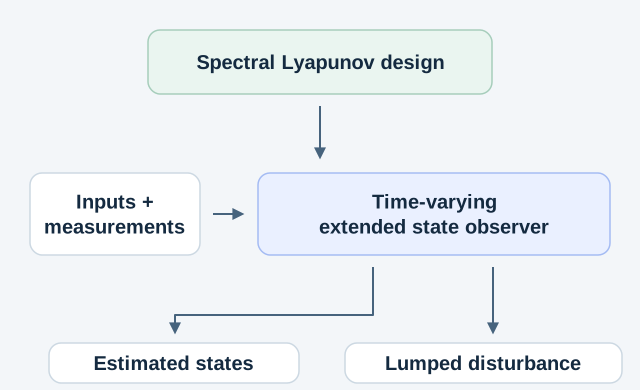
Design theory determines the observer parameters; the observer estimates states and the combined effect of unknown dynamics.
Design theory determines the observer parameters; the observer estimates states and the combined effect of unknown dynamics.View full size ↗

The problem

Unknown nonlinear dynamics and disturbances make state estimation difficult. Observer tuning must also control the size of transient and persistent errors.

The main idea

Combine differential algebraic spectral theory with a spectral Lyapunov function to design a time-varying extended state observer. Time-varying parallel differential eigenvalues guide the observer’s bandwidth and parameters.

What the paper shows

The publisher abstract reports estimation-error analysis, comparisons on the TMUBOT quadruped model, and a practical implementation on the robot.

Scope & limitations

This overview is based on the publisher abstract. It does not reproduce the theorem assumptions, tuning procedure, or quantitative results; consult the article for those details.

Journal article · Journal of Intelligent & Robotic Systems

Analysis and Design of a Time-Varying Extended State Observer for a Class of Nonlinear Systems with Unknown Dynamics Using Spectral Lyapunov Function

Mehran Attar, Vahid Johari Majd, and Navid Dini

Summary based on: Publisher abstract ↗

View citation BibTeX + copy

Published online in 2018; the journal issue and citation are dated 2019.

@article{attar2019spectral,
  title = {Analysis and Design of a Time-Varying Extended State Observer for a Class of Nonlinear Systems with Unknown Dynamics Using Spectral Lyapunov Function},
  author = {Mehran Attar and Vahid Johari Majd and Navid Dini},
  year = {2019},
  journal = {Journal of Intelligent and Robotic Systems},
  volume = {94},
  number = {2},
  pages = {405--421},
  doi = {10.1007/s10846-018-0935-0}
}
06Learning2019

How can an agent improve its decisions through experience?

Connect the action–reward loop to Q-learning, then move from a table of values to feature-based approximation.

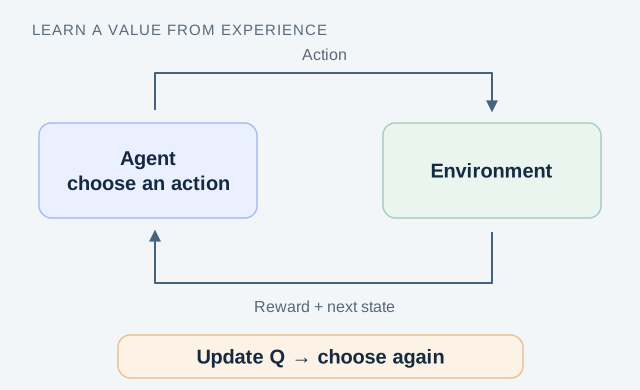
The agent learns from reward and the next state after acting. Q-values summarize the expected value of future decisions.
The agent learns from reward and the next state after acting. Q-values summarize the expected value of future decisions.View full size ↗

The problem

An agent acting in an uncertain environment needs to learn which actions produce useful long-term outcomes.

The main idea

The tutorial introduces Markov decision processes, temporal-difference learning, Q-learning, and approximate Q-learning. Worked gridworld and Pacman examples connect the definitions to updates of action values.

What the paper shows

Its contribution is educational: an accessible path from basic concepts to example learning procedures. It is a tutorial preprint, rather than a new algorithm with a performance benchmark.

Scope & limitations

Tabular methods grow with the state–action space; function approximation introduces dependence on the chosen features. The examples do not establish general safety or convergence guarantees for arbitrary dynamical systems.

Tutorial preprint · arXiv · 1905.07727

Reinforcement Learning for Learning of Dynamical Systems in Uncertain Environment: A Tutorial

Mehran Attar and Mohammadreza Dabirian

Summary based on: Full tutorial manuscript ↗

View citation BibTeX + copy
@misc{attar2019rl,
  title = {Reinforcement Learning for Learning of Dynamical Systems in Uncertain Environment: A Tutorial},
  author = {Mehran Attar and Mohammadreza Dabirian},
  year = {2019},
  eprint = {1905.07727},
  archivePrefix = {arXiv},
  primaryClass = {cs.LG},
  doi = {10.48550/arXiv.1905.07727}
}
07Robotics & estimation2016

Can joint-level observers handle an uncertain, coupled robot?

Treat coupling and unknown dynamics as quantities to estimate, while varying observer gains to reduce the initial error peak.

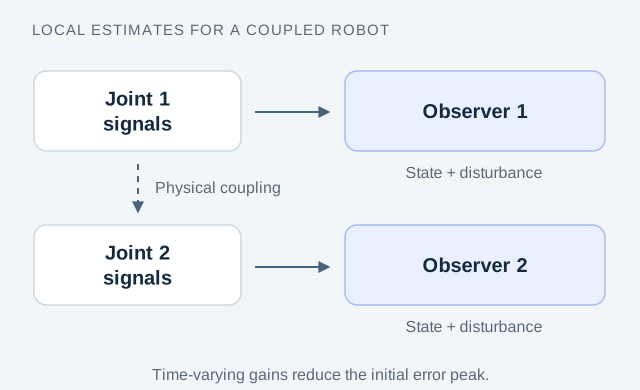
A local observer does not mean an independent joint: coupling remains part of the unknown dynamics to be estimated.
A local observer does not mean an independent joint: coupling remains part of the unknown dynamics to be estimated.View full size ↗

The problem

A two-joint manipulator has interacting dynamics and uncertainty. Decentralized design is simpler, but the effects of coupling still need to be handled.

The main idea

Use a time-varying extended state observer to estimate the states and combined unknown dynamics for each subsystem, including disturbances associated with joint coupling.

What the paper shows

The author-uploaded abstract reports simulation comparisons in which time-varying gains reduce the peaking of estimation error relative to the compared observers.

Scope & limitations

The accessible summary supports a simulation-based result for the studied two-degree-of-freedom manipulator. It does not establish experimental validation or universal superiority across robot designs.

Conference paper · ICROM · pp. 116–121

Estimation of Decenteralized Unknown Dynamics for a 2DOF Manipulator Using a Time Varying Extended State Observer

Mehran Attar, Vahid Johari Majd, Navid Dini, and Farid Edrisi

Summary based on: Author-uploaded abstract and figure descriptions ↗

View citation BibTeX + copy
@inproceedings{attar2016manipulator,
  title = {Estimation of Decenteralized Unknown Dynamics for a 2DOF Manipulator Using a Time Varying Extended State Observer},
  author = {Mehran Attar and Vahid Johari Majd and Navid Dini and Farid Edrisi},
  year = {2016},
  booktitle = {2016 4th International Conference on Robotics and Mechatronics (ICROM)},
  pages = {116--121},
  doi = {10.1109/ICRoM.2016.7886827}
}
08Robotics & estimation2016

How can a quadruped correct its posture when the ground tilts?

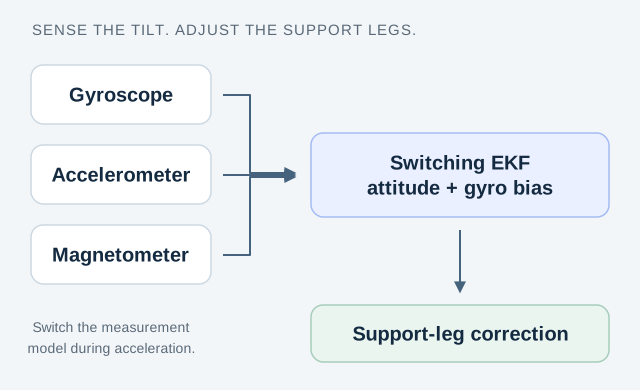
Fuse complementary sensor signals, then use the estimated orientation to adjust the supporting legs.

The switching rule helps prevent acceleration from being mistaken for tilt; the support legs act on the resulting attitude estimate.
The switching rule helps prevent acceleration from being mistaken for tilt; the support legs act on the resulting attitude estimate.View full size ↗

The problem

Gyroscope bias and body acceleration complicate attitude estimation. An inaccurate estimate can undermine the robot’s posture correction.

The main idea

Fuse gyroscope, accelerometer, and magnetometer data with a switching extended Kalman filter. Change the measurement model between accelerated and non-accelerated motion, estimate orientation and gyro bias, and compensate body deviation through the support legs.

What the paper shows

The paper reports a simulation comparison with a nonlinear observer and body-attitude correction on a platform subject to ramp disturbances.

Scope & limitations

The reported task concerns attitude estimation and support-leg posture correction. It does not establish general dynamic walking, arbitrary terrain handling, or recovery from all external pushes.

Conference paper · ICROM · pp. 55–60

Modifying the Attitude of Quadruped Robot Body against Disturbances via Data Fusion

Farid Edrisi, Vahid Johari Majd, Mehran Attar, and Navid Dini

Summary based on: Author manuscript · abstract and method description ↗

View citation BibTeX + copy
@inproceedings{edrisi2016attitude,
  title = {Modifying the Attitude of Quadruped Robot Body against Disturbances via Data Fusion},
  author = {Farid Edrisi and Vahid Johari Majd and Mehran Attar and Navid Dini},
  year = {2016},
  booktitle = {2016 4th International Conference on Robotics and Mechatronics (ICROM)},
  pages = {55--60},
  doi = {10.1109/ICRoM.2016.7886817}
}
09Robotics & estimation2016

Can a robot infer contact forces without dedicated force sensors?

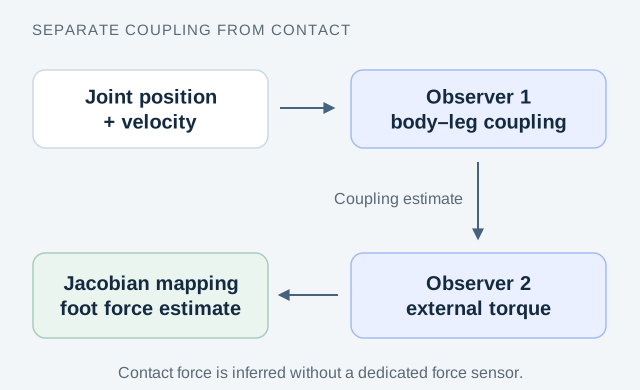
Separate body–leg coupling from environmental contact before mapping estimated torques to foot forces.

The observers are connected in stages: estimate coupling first, then estimate external torque and recover contact force.
The observers are connected in stages: estimate coupling first, then estimate external torque and recover contact force.View full size ↗

The problem

Joint measurements reflect both internal coupling and external contact. An observer that mixes these effects can misattribute the forces acting on a robot leg.

The main idea

Use two connected nonlinear disturbance observers. The first estimates coupling torques; the second uses that information to estimate external torques. A Jacobian maps the torque estimate to a force estimate using joint position and velocity measurements.

What the paper shows

The manuscript reports convergence properties for slowly varying torques, bounded-error behavior for faster changes, and simulation comparisons on the TMUBot model.

Scope & limitations

Force variation rate affects estimation accuracy. The reported validation is simulation-based; the result does not imply exact recovery of arbitrarily fast contact forces.

Conference paper · ICROM · pp. 72–77

Estimation of External Forces Acting on the Legs of a Quadruped Robot Using Two Nonlinear Disturbance Observers

Navid Dini, Vahid Johari Majd, Farid Edrisi, and Mehran Attar

Summary based on: Author manuscript · abstract and figure descriptions ↗

View citation BibTeX + copy
@inproceedings{dini2016forces,
  title = {Estimation of External Forces Acting on the Legs of a Quadruped Robot Using Two Nonlinear Disturbance Observers},
  author = {Navid Dini and Vahid Johari Majd and Farid Edrisi and Mehran Attar},
  year = {2016},
  booktitle = {2016 4th International Conference on Robotics and Mechatronics (ICROM)},
  pages = {72--77},
  doi = {10.1109/ICRoM.2016.7886820}
}